
 GLOW GHK-Cu (45mg) / BPC-157 (10mg) / TB500 (10mg)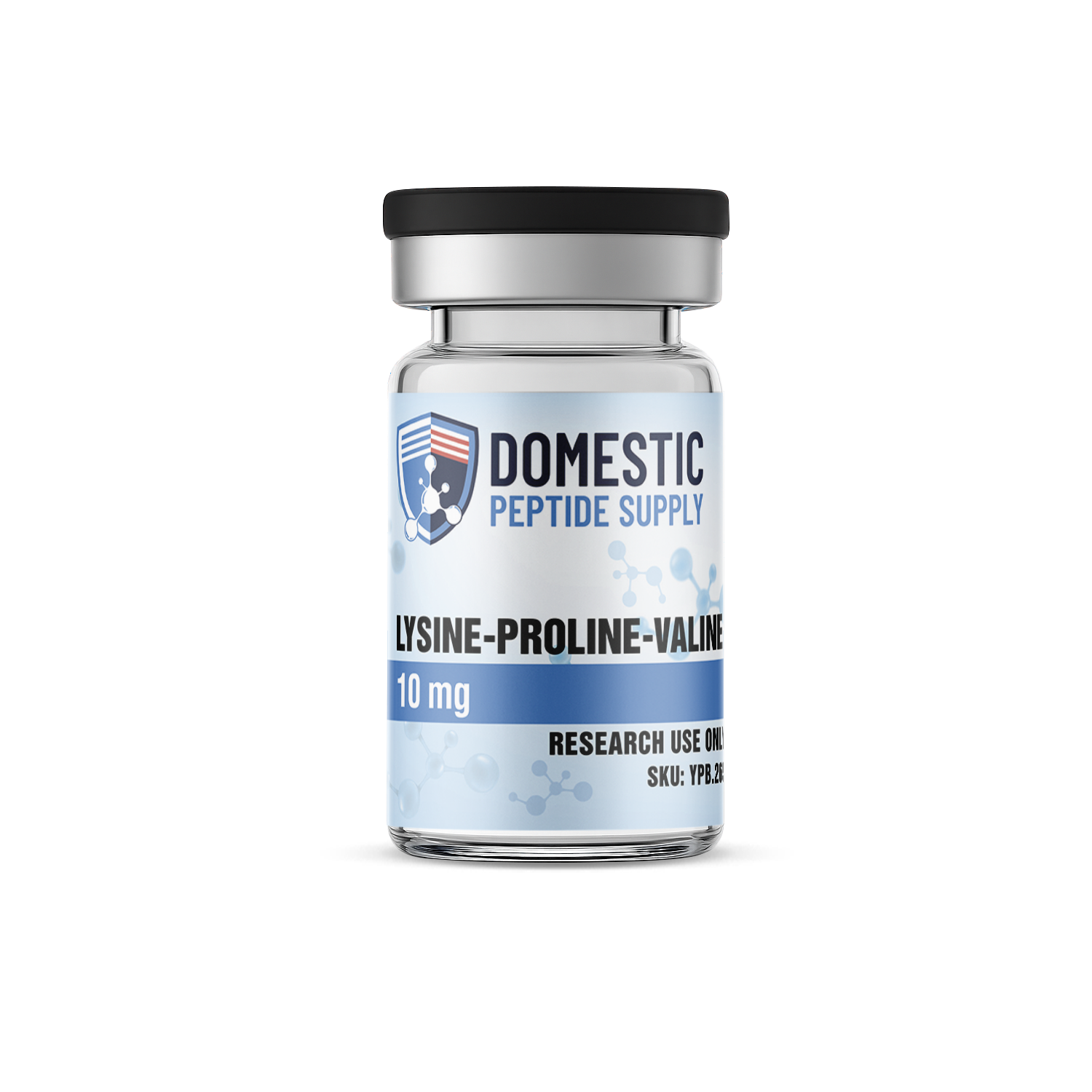
LYSINE-PROLINE-VALINE (10mg)
$115.00
Description
A single-component research material supplied for controlled research environments. Lysine–Proline–Valine (KPV) is a synthetic tripeptide commonly used in research investigating inflammation pathways, immune signaling, and tissue response models.
Composition
• Lysine–Proline–Valine (KPV)
• Appearance: Lyophilized powder in a sealed research vial
Research Focus (non-clinical)
• In-vitro studies examining KPV’s role in modulating inflammatory pathways
• Investigation of its potential effects on immune cell signaling
• Development of analytical methods for tripeptide characterization (HPLC/LC-MS)
• Stability and solubility profiling of KPV under controlled laboratory storage conditions
For qualified research professionals and institutional laboratories. Not for human use.
Documentation & Quality Assurance
Each lot is sourced through our verified global supply chain with emphasis on traceability and quality control. We work diligently to obtain and maintain third-party analytical reports (HPLC/LC-MS) and Certificates of Analysis for each batch, as part of our ongoing quality process. These documents are reviewed internally and displayed as they become available. Independent third-party testing is also performed on select lots to confirm identity, purity, and alignment with our internal specifications.
Important Notice
This product is intended for laboratory research use only. It is not intended for human or veterinary use, and must not be used for diagnostic, therapeutic, or clinical purposes.
This material is not a drug, medical device, or dietary supplement, and has not been evaluated by the U.S. Food and Drug Administration.
Quality & Manufacturing
All materials are sourced from carefully vetted domestic and international manufacturing partners who follow quality systems consistent with ISO and cGMP principles. Each supplier is reviewed for reliability, documentation integrity, and transparency in testing.
We require a verified purity of 99% or higher and perform independent third-party spot testing to confirm that select lots meet our internal standards for identity, purity, and composition. Where available, endotoxin testing results are included on Certificates of Analysis to verify laboratory purity; their inclusion is for research quality assessment only and does not imply suitability for human or veterinary use.
All research materials are sealed for integrity and packaged for stability during storage and transport from manufacturing through final delivery.
Additional information
| Weight | 0.2 lbs |
|---|
Storage Instructions
All our research peptides are manufactured using a lyophilization (freeze-drying) process. This method is designed to maintain product integrity and allows vials to remain stable during shipping for approximately 3–4 months.
Once a vial is reconstituted with bacteriostatic water, it should be stored in the refrigerator to help maintain stability. Under these conditions, reconstituted material is generally considered stable for up to 30 days.
Lyophilization is a dehydration technique in which compounds are frozen and then exposed to low pressure. This causes the water in the vial to sublimate directly from solid to gas, leaving behind a stable, crystalline white structure. This powder can be kept at room temperature until reconstitution.
Upon receipt, products should be stored away from heat and light. For short-term use, refrigeration at approximately 4°C (39°F) is suitable. For long-term storage (several months to years), vials may be placed in a freezer at approximately -80°C (-112°F). Freezing is the preferred method for preserving product stability over extended periods.
⚠️ Important Notice: These products are intended for research use only. Not for human consumption.
Certificate of Analysis
Every batch undergoes rigorous third-party laboratory testing to verify identity, purity (≥98%), and quality before release.
View Certificate of AnalysisResearch Use Only
These studies reference research-grade peptides for laboratory and scientific investigation only. Not for human consumption. Not intended to diagnose, treat, cure, or prevent any disease.
Published Scientific Research
Peer-reviewed laboratory research investigating research peptides from leading scientific databases
Natural sources and bioactive mechanisms of anti-inflammatory peptides: from digestive metabolism to bioavailability enhancement strategies.
In this review, the multiple natural sources of AIPs (including marine organisms, terrestrial plants and animals, and microorganisms) are comprehensively reviewed, and their core molecular mechanisms to inhibit inflammatory responses through the synergistic regulation of key signaling pathways such as NF-κB, MAPK, PI3K/Akt, JAK/STAT, and Keap1-Nrf2 are examined. To address the bioavailability bottlenecks of AIPs' oral delivery, such as gastrointestinal degradation and low intestinal permeability, this review systematically analyzes the mechanisms of action of enhancement strategies, including nanocarrier technologies and chemical modification methods.
View Full StudyLeveraging coevolutionary insights and AI-based structural modeling to unravel receptor-peptide ligand-binding mechanisms.
Secreted signaling peptides are central regulators of growth, development, and stress responses, but specific steps in the evolution of these peptides and their receptors are not well understood. Also, the molecular mechanisms of peptide-receptor binding are only known for a few examples, primarily owing to the limited availability of protein structural determination capabilities to few laboratories worldwide.
View Full StudyThe functional role of m6A demethylase ALKBH5 in cardiomyocyte hypertrophy.
The m6A demethylase ALKBH5 is reported to be associated with cardiovascular diseases, whereas the functional role of ALKBH5 in cardiomyocyte hypertrophy remains confused. Subsequently, RNA immunoprecipitation (RIP)-qPCR, MeRIP-qPCR analysis and the dual-luciferase reporter assays were applied to elucidate the regulatory mechanism of ALKBH5 on cardiomyocyte hypertrophy.
View Full StudyRice bran active peptide (RBAP) inhibited macrophage differentiation to foam cell and atherosclerosis in mice via regulating cholesterol efflux.
Recent findings highlight the significance of cholesterol removal pathways in influencing atherosclerosis, yet the connection between cholesterol removal and regulation of macrophage inflammation remains poorly understood. RBAP could serve as an anti-inflammatory agent; however, its role in atherosclerosis and the mechanism behind it are still not well understood.
View Full StudyWhat doesn't kill you makes you stranger: Dipeptidyl peptidase-4 (CD26) proteolysis differentially modulates the activity of many peptide hormones and cytokines generating novel cryptic bioactive ligands.
In this review we discuss the idea that DPP4-cleaved peptides are not necessarily inactivated, but rather can possess either a modified receptor selectivity, modified bioactivity, new antagonistic activity, or even a novel activity relative to the intact parent ligand. For example, GLP-1 can work through a different receptor than GLP-1R, DPP4-cleaved GIP can function as a GIP receptor antagonist at high doses, and DPP4-cleaved PYY, NPY, and CXCL12 can have different receptor selectivity, or can bind novel, previously unrecognized receptors to their intact ligands, resulting in altered signaling and functionality.
View Full StudyAntiinflammatory activity of a COOH-terminal fragment of the neuropeptide alpha-MSH.
The endogenous neuropeptide alpha-melanocyte stimulating hormone (alpha-MSH 1-13), previously found to have marked antipyretic activity, inhibits histamine-induced increases in vasopermeability. To test this idea, the effects of graded doses of alpha-MSH [11-13] on ear swelling induced by picryl chloride in mice were compared with the effects of saline and a large dose of corticosteroid.
View Full StudyRelated products
-
-
-
Epitalon
Price range: $95.00 through $145.00Select options This product has multiple variants. The options may be chosen on the product page